Blog Home Page

Showing posts with label Sumer. Show all posts

Tuesday, July 8, 2014

Final Proof that the Sumerian Tiamat was a Woman and Not a Planet


The Pacific Ocean - The Sea Water was Symbolic of Tiamat who settled in Tyre
 

This is the final proof needed from Sumerian mythology to show that Tiamat was a woman and not a planet:

(Then Marduk addressed him, saying)

'Father, don't stay so silent, open you lips,
Let me go, and let me fulfill your heart's desire.
Anshar, don't stay so silent, open your lips,
Let me go, and let me fulfill your heart's desire.'

(Anshar replied)

'What kind of man has ordered you out (to) his war?
My son, (don't you realize that) it is Tiamat, of womankind,
who will advance against you with arms?'

(Marduk answered)

'Father,  my creator, rejoice and be glad!
You shall soon set your foot upon the neck of Tiamat!
Anshar, my creator, rejoice and be glad,
You shall soon set your foot upon the neck of Tiamat.'


(The Epic of Creation from Myths From Meosopotamia by Stephanie Dalley page 243.)


While I realize that interpretations of the ancient Sumerian-Babylonian mythology can vary, this is clear enough. Tiamat was a woman murdered by her great-grandson and that ushered in the patriarchy that changed into Paganism and then into all the Abrahamic religions including Satanism.

Even though Zechariah Sitchen brought a lot of interest back to the Sumerian mythology, I have to wonder if he deliberately misled the people because the secrets of the past are well hidden and well guarded.  This was a Patriarchy formed on the murder and mutilation of an elderly man and an elderly woman.


by Rita Jean Moran (www.thelibrarykids.com and www.hiddenhumanstory.com)

Monday, July 7, 2014

The Sumerian Gods were the Same as the Cronides and they were Caucasoid

I have shown how these ancient gods/goddesses from Sumer are the same people as the Cronide family I have been writing about.  These people were originally from Tyre and Crete.  They spread their kingdoms/queendoms all over the world and travelled via ships (proven through ancient literature I have exposed and the petroglyphs that I found in Nevada) on the waterways to the entire world to end savagery and cannibalism (shown in my books and hundreds of articles I've been writing on both of my blogs).  None of them were little grey aliens or hybrids.  They were human, albeit they may have been a different human species or exhibited strange skull characteristics due to excessive inbreeding.

They were described as fair and bright eyed in Sumerian-Babylonian literature and as blonde, red-haired, auburn-haired, and blue-eyed in Greek and Roman literature.  So far, I have shown you the proof of my Mythological Unification Theory through not only quoting ancient literature that directly says Dionysus is Osiris, but I have shown you through comparative mythology that the Cronides I have been revealing to all of you, are the same people that are the ancient gods/goddesses of Egypt, Sumer, Greece, Rome, and the Nordic lands.

I will move on to Celtic, Hindu, Mesoamerican, South American, Native American, Aborigine, and various Asian mythologies next, to show you they are all referring to this ancient Cronide family.  After this, I will then show you how this ancient family is encoded in the Bible.

Lastly, the contested Sumerian plate of Enlil with an alleged 10th planet called Nibiru is probably more a diagram of Saturn and all of its moons that they could see.  I've already shown you through the literature that Nibiru/Neberu was a star and not a planet and it was associated with Anu-Uranus and not Cronus-Enlil.  It's time to take a better look at the pop culture surrounding the ancient Sumerians and not fall for the hype.  That so called 10th planet looks more like a Jewish Star of David than it does a planet and the hexagram/Star of Remphan was a symbol associated with Cronus who did do human sacrifice of his own children.


Sitchin posing with an enlarged, purported 6000-year-old cylinder seal impression


Hexagram in Islamic stonework at the Qutb complex, Delhi, India


by Rita Jean Moran (www.thelibrarykids.com and www.hiddenhumanstory.com)


Links:

http://en.wikipedia.org/wiki/Cylinder_seal


http://en.wikipedia.org/wiki/Zecharia_Sitchin


http://en.wikipedia.org/wiki/Remphan

The Sumerian Dumuzi is the Greek Dionysus


The marriage of Inanna and Dumuzid


Dionysus


One of the lovers of Inanna/Ishtar was Dumuzi.  He was killed by several other people as talked about in Sumerian-Babylonian myth entitled, The Dream of Dumuzi.  In it he tells his sister-wife, Geshtinanna about a bad dream he had regarding his murder (sounds like Balder's dream from Nordic mythology).  She does not want to hear it but tells him it is a bad sign.  At the end of the poem, Dumuzi is accosted by several men and murdered. This is the only Sumerian God that is murdered just as Dionysus-Osiris and his other names was the only God who was murdered.  The description of the murder involves being bludgeoned to death as opposed to the Egyptian story of Osiris being locked in a coffin to die and the Nordic story of the mistletoe arrow killing Balder.  But there is only one God that is murdered in all mythologies by a group of men and so I conclude that Dumuzi is the Greek Dionysus.  Here are some passages from the ancient Sumerian-Babylonian myth, The Dream of Dumuzi:


The galla surrounded Dumuzi.
They bound his hands; they bound his neck.
They beat the husband of Inanana.
Dumuzi raised his arms to heaven, to Utu, the God of Justice,
and cried out:

"O Utu, you are my brother-in-law,
I am the husband of your sister.
I am the one who carried food to the holy shrine.
I am the one who brought wedding gifts to Uruk.
I kissed the holy lips.
I danced on the holy knees, the knees of Inanna.

Change my hands into the hands of a gazelle.
Change my feet into the feet of a gazelle.
Let me escape from my demons.
Let me flee to Kubiresh!"


Dumuzi escapes but is found again and beaten to death by the men who attacked him.


The galla climbed the reed fence.
The first galla struck Dumuzi on the cheek with a piercing nail,
The second galla struck Dumuzi on the other check with the shepherd's
crook,
The third galla smashed the bottom of the churn,
The fourth galla threw the drinking cup down from its peg,
The fifth galla shattered the churn,
The sixth galla shattered the cup,
The seventh galla cried:
"Rise, Dumuzi!
Husband of Inanna, son of Situr, brother of Geshtinanna!
Rise from your false sleep!
Your ewes are seized! Your lambs are seized!
Your goats are seized! Your kids are seized!
Take off your holy crown from your head!
Take off your me-garment from your body!
Let your royal sceptre fall to the ground!
Take of your holy sandals from your feet!
Naked, you go with us!"

The galla seized Dumuzi.
They surrounded him.
They bound his hands.  They bound his neck.

The churn was silent.  No milk poured.
The cup was shattered.  Dumuzi was no more.
The sheepfold was given to the winds.


(Inanna Queen of Heaven and Earth Her Stories and Hymns from Sumer by Diane Wolkstein and Samuel Noah Kramer pages 81-84.)


by Rita Jean Moran (www.thelibrarykids.com and www.hiddenhumanstory.com)


Links:

http://en.wikipedia.org/wiki/Dumuzid_the_Shepherd

Wednesday, July 2, 2014

The Library of Ashurbanipal and Dr. Samuel Noah Kramer


Tablet containing part of the Epic of Gilgamesh (Tablet 11 depicting the Deluge), now part of the holdings of the British Museum 


The last king of the Neo-Assyrian Empire, King Ashurbanipal, created a library consisting of thousands of clay tablets from the 7th century BC.  This library was burned down after an attack on the kingdom and the fire actually preserved the clay tablets.  This library contained famous stories from Ancient Sumerian-Akkadian-Assyrian-Babylonian mythology such as the Epic of Gilgamesh and various other mythological stories.

The material was found at the archaeological site of Kouyunjik which is ancient Ninevah (the capital of Assyria) in northern Mesopotamia (modern day Iraq) during the middle 1800s.  The Library was discovered by Austen Henry Layard and most of the tablets were taken to the British Museum.  Many of the tablets were written in Akkadian  in the cuneiform script.  Per Wikipedia:


The library is an archaeological discovery credited to Austen Henry Layard; most tablets were taken to England and can now be found in the British Museum, but a first discovery was made in late 1849 in the so-called South-West Palace, which was the Royal Palace of king Sennacherib (705 – 681 BC).
Three years later, Hormuzd Rassam, Layard's assistant, discovered a similar "library" in the palace of King Ashurbanipal (668 - 627 BC), on the opposite side of the mound. Unfortunately, no record was made of the findings, and soon after reaching Europe, the tablets appeared to have been irreparably mixed with each other and with tablets originating from other sites. Thus, it is almost impossible today to reconstruct the original contents of each of the two main "libraries".
Ashurbanipal was known as a tenacious martial commander; however, he was also a recognized intellectual who was literate, and a passionate collector of texts and tablets.[5] As an apprentice scribe he mastered both the Akkadian and the Sumerian languages [6] He sent scribes into every region of the Neo-Assyrian Empire to collect ancient texts. He hired scholars and scribes to copy texts, mainly from Babylonian sources.[2][3]
Ashurbanipal was not above using war booty as a means of stocking his library. Because he was known for being a scholar and being cruel to his enemies, Ashurbanipal was able to use threats to gain materials from Babylonia and surrounding areas.[7]
The royal library consists of approximately 30,000 tablets and writing boards with the majority of them being severely fragmented. [8] It can be gleaned from the conservation of the fragments that the number of tablets that existed in the library at the time of destruction was close to two thousand and the number of writing boards within the library can be placed at a total of three hundred.[9] The majority of the tablet corpus (about 6,000) included colloquial compositions in the form of legislation, foreign correspondences and engagements, aristocratic declarations, and financial matters. [10] The remaining texts contained divinations, omens, incantations and hymns to various gods, while others were concerned with medicine, astronomy, and literature. For all these texts in the library only ten contain expressive rhythmic literary works such as epics and myths.[11] The Epic of Gilgamesh, a masterpiece of ancient Babylonian poetry, was found in the library as was the Enûma Eliš creation story, and myth of Adapa the first man, and stories such as the Poor Man of Nippur.[12][13][14]
The texts were principally written in Akkadian in the cuneiform script, however many of the tablets do not have an exact derivation and it is often difficult to ascertain their original homeland. Many of the tablets are indeed composed in the Neo-Babylonian Script, but many were also known to be written in Assyrian as well. [15] 


It is from this library that the mythology of ancient Sumer was determined.


Nineveh was destroyed in 612 BC by a coalition of Babylonians, Scythians and Medes, an ancient Iranian people. It is believed that during the burning of the palace, a great fire must have ravaged the library, causing the clay cuneiform tablets to become partially baked.[13] Paradoxically, this potentially destructive event helped preserve the tablets. As well as texts on clay tablets, some of the texts may have been inscribed onto wax boards which because of their organic nature have been lost.
The British Museum’s collections database counts 30,943 "tablets" in the entire Nineveh library collection, and the Trustees of the Museum propose to issue an updated catalog as part of the Ashurbanipal Library Project.[17] If all smaller fragments that actually belong to the same text are deducted, it is likely that the "library" originally included some 10,000 texts in all. The original library documents however, which would have included leather scrolls, wax boards, and possibly papyri, contained perhaps a much broader spectrum of knowledge than that known from the surviving clay tablet cuneiform texts.


Ashurbanipal on a chariot during a royal lion hunt. (Reign 668-627 BC)


King Ashurbanipal was not a very nice man, but a rather violent king despite his scholarly achievements.  Per Wikipedia:

Despite being a popular king among his subjects, he was also known for his cruelty to his enemies. Some pictures depict him putting a dog chain through the jaw of a defeated king and then making him live in a dog kennel.[8] Many paintings of the period exhibit his brutality.[original
Assyria was by then master of the largest empire the world had yet seen, stretching from The Caucasus in the north to North Africa in the south, and from the east Mediterranean in the west to central Iran in the east. Ashurbanipal enjoyed the subjugation of Babylon, Chaldea, Media, Persia, Egypt, Elam, Gutium, Phrygia, Mannea, Corduene, Aramea, Urartu, Lydia, Cilicia, Commagene, Caria, Phoenicia, Israel, Judah, Samarra, Moab, Edom, Nabatea, Arabia, the Neo-Hittites, Dilmun, Nubia, Scythia, Cimmeria, Armenia and Cyprus, with few problems during Ashurbanipal's reign. For the time being, the dual monarchy in Mesopotamia went well.[10]


The famous library of king Ashurbanipal at Nineveh


Among the findings was the Enuma Elish, also known as the Epic of Creation,[23] which depicts a traditional Babylonian view of creation where the god Marduk slays Tiamat, the personification of salt water, and creates the world from her body. In this particular version, man is created from the blood of a revolting god, Qingu, in order to toil on behalf of the gods.

I will soon show in future posts, that Marduk is a Babylonian name for the Greek Uranus (who killed his great-grandmother and great-grandfather).


Dr. Samuel Noah Kramer


A PHD named Dr. Samuel Noah Kramer was one of the world's leading Assyriologists and a world renowned expert in Sumerian history and Sumerian language.  He came from Russia and ended up working on deciphering the tablets at the University of Pennsylvania.  From Wikipedia:

In his autobiography published in 1986, he sums up his accomplishments: "First, and most important, is the role I played in the recovery, restoration, and resurrection of Sumerian literature, or at least of a representative cross section . . . Through my efforts several thousand Sumerian literary tablets and fragments have been made available to cuneiformists, a basic reservoir of unadulterated data that will endure for many decades to come. Second, I endeavored . . . to make available reasonably reliable translations of many of these documents to the academic community, and especially to the anthropologist, historian, and humanist. Third, I have helped to spread the name of Sumer to the world at large, and to make people aware of the crucial role the Sumerians played in the ascent of civilized man".[3]
Kramer died at age 93 on November 26, 1990 in the United States.

So you can see that Dr. Samuel Noah Kramer along with his mentor,  Ephraim Avigdor Speiser, was one of the first to decipher the Sumerian cuneiform clay tablets from the Library of Ashurbanipal.


Here are some of his selected writings that we will be studying from:


  • Kramer, Samuel Noah. Sumerian Mythology: Study of Spiritual and Literary Achievement in the Third Millennium B.C. 1944, rev. 1961.

  • Kramer, Samuel Noah. History Begins at Sumer: Thirty-Nine Firsts in Man's Recorded History. 1956/1e (25 firsts), 1959/2e (27 firsts) 1981/3e. University of Pennsylvania Press. ISBN 0-8122-7812-7.

  • Kramer, Samuel Noah. The Sumerians: Their History, Culture and Character. Chicago, IL: University of Chicago Press, 1963. ISBN 0-226-45238-7.

  • Kramer, Samuel Noah and Diane Wolkstein. Inanna : Queen of Heaven and Earth. New York: Harper & Row, 1983. ISBN 0-06-090854-8.

  • Kramer, Samuel Noah. In the World of Sumer, An Autobiography. Wayne State University Press, 1988. ISBN 0-8143-1785-5.


  • There are other scholars who have deciphered the cuneiform text that we will be looking at as well.  The most famous self-professed, self-taught anthropologist who has claimed to have given a new interpretation to the Sumerian-Akkadian Cuneiform clay tablets is Zechariah Sitchin.  We'll be looking into his work as well and comparing the decipherments versus the interpretations.
     
    As you can see by the description from Wikipedia, Zechariah Sitchin did not have the credentials claimed to decipher the Sumerian tablets, but it appears to me he made interpretations of work done by Dr. Samuel Noah Kramer.  However, I will be open to the case of him being self-taught as many have done in the past as he has claimed.
     
     
    Sitchin was born in the Azerbaijan SSR, but was raised in Mandatory Palestine. He received a degree in economics from the University of London, and was an editor and journalist in Israel, before moving to New York in 1952. While working as an executive for a shipping company, he taught himself Sumerian cuneiform and visited several archaeological sites.[3][4]
     

    Links:

    http://en.wikipedia.org/wiki/Akkadian_language

    http://en.wikipedia.org/wiki/Ashurbanipal

    http://en.wikipedia.org/wiki/Samuel_Noah_Kramer

    http://en.wikipedia.org/wiki/Sumer

    http://www.nytimes.com/1990/11/27/obituaries/samuel-noah-kramer-93-dies-was-leading-authority-on-sumer.html

    http://www.sacred-texts.com/ane/sum/

    http://he.wikipedia.org/wiki/%D7%A7%D7%95%D7%91%D7%A5:Samuel_Noah_Kramer.jpg

    http://en.wikipedia.org/wiki/Zecharia_Sitchin

    The Sumerians


    The Samarra bowl, at thePergamonmuseum, Berlin. Theswastika in the center of the design is a reconstruction.[17]


    The Sumerians lived in ancient Mesopotamia between the Tigris and Euphrates rivers, which is now modern day Iraq.  Their civilization existed about 6000 years ago (4000 BC).  Their cities included Ur, Eridu, Larsa, Isisn, Adab, Nippur, and Kish.

    Each city-sate was independent and ruled by a king called a lugal, or en.  The main temple of each city was a ziggurat.  Most people were farmers in ancient Sumer.  There were scholars, fishermen, craftspeople, merchants, and other professions.  Slavery existed and disobedient children could be sold into slavery.

    The Sumerians had many gods and goddesses that they worshipped.

    The Sumerian civilization gave way to the Akkadians which then gave way to the Assyrians.  The Assyrians gave way to the Babylonians and finally into the modern country of Iraq.

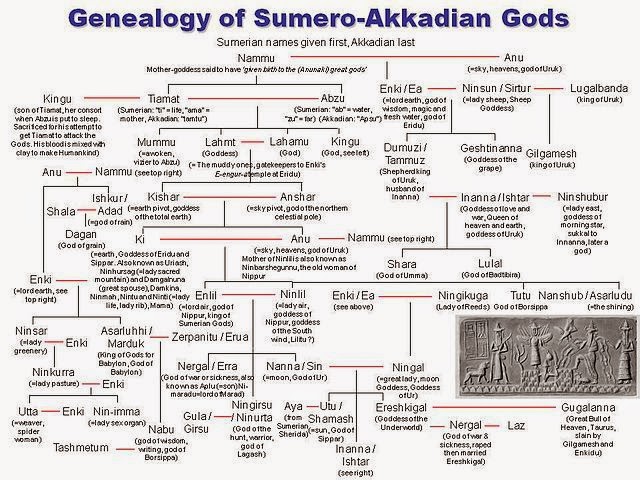
    The four most important gods/goddesses of ancient Sumer were:

    An - The heaven god of the calendars and seasons.

    Enlil - The storm god known as the father of the gods and king of heaven and earth.  He created agricultural tools.

    Enki - The water god and god of wisdom who organized the earth per Enlil's instructions.

    Ninhursag - The earth goddess and great mother -goddess.


    I will show through the ancient myths that these gods/goddesses correspond to the Greek gods as follows:


    An is the equivalent of Uranus.

    Enlil is the equivalent of Cronus.

    Enki  is the equivalent of Zeus.

    Ninhursag is the equivalent of Demeter.


    Some of their other gods/goddesses included:


    Nanna (probably another name for Zeus)

    Utu (Apollo)

    Ishtar (Aphrodite)

    Ereshkigal (Persephone)

    Tiamat ( a great grandmother of Anu-Uranus)

    Abzu ( a great grandfather of Anu-Uranus)

    Dumuzi (Dionysus)

    Gilgamesh (Heracles)


    The Sumerians worshipped their gods/goddesses and also believed in a life after death.  They used a writing form known as Cuneiform to record their stories, records, and contracts.  The Sumerians were not a Semitic people.  The Sumerian culture and subsequent cultures declined because of the invasions by Akkadian Semites who finally took over with King Hammurabi in Babylon and the establishment of the Babylonian Empire as their last great empire (Akkadian kings took over about 4200 years ago).


    Bill of sale of a male slave and a building in Shuruppak, Sumerian tablet, circa 2600 BC


    Because Sumer was a collection of city-states, there was no strong national defense and this is one reason they were taken over.  The ancient gods/goddesses of the Sumerians were the Cronides who traveled the world.  I will be showing this through the ancient myths and the application of the Mythological Unification Theory.


    Early chariots on the Standard of Ur, c. 2600 BC.


    Just like the Egyptian Empire, the Sumerian Empire was taken over by Semites and run into the ground.  Like most empires, the disgusting usage of slaves (captured people) was present since the people were either too lazy or not self-reliant enough to do their menial labor.  It appears it only took a couple of hundred years to destroy ancient Sumer just as the Hyksos did in ancient Egypt.  From Wikipedia:


    The Akkadian Empire reached its political peak between the 24th and 22nd centuries BC, following the conquests by its founder Sargon of Akkad (2334–2279 BC). Under Sargon and his successors, Akkadian language was briefly imposed on neighboring conquered states such as Elam. Akkad is sometimes regarded as the first empire in history,[7] though there are earlier Sumerian claimants.[8]
    After the fall of the Akkadian Empire, the Akkadian people of Mesopotamia eventually coalesced into two major Akkadian speaking nations: Assyria in the north, and, a few centuries later, Babylonia in the south. 


    Important Canaanite populations first appeared in Egypt towards the end of the 12th Dynasty c. 1800 BC, and either around that time or c. 1720 BC, formed an independent realm in the eastern Nile Delta.[5] The Canaanite rulers of the Delta, regrouped in the14th Dynasty, coexisted with the Egyptian 13th Dynasty, based in Itjtawy. The power of the 13th and 14th dynasties progressively waned, perhaps due to famine and plague,[5][6] and c. 1650 BC both were invaded by the Hyksos, who formed their own dynasty, the 15th Dynasty. The collapse of the 13th Dynasty created a power vacuum in the south, which may have led to the rise of the 16th Dynasty, based in Thebes, and possibly of a local dynasty in Abydos.[5] Both were eventually conquered by the Hyksos, albeit for a short time in the case of Thebes. From then on, the 17th Dynasty took control of the Thebes and reigned for some time in peaceful coexistence with the Hyksos kings, perhaps as their vassals. Eventually, Seqenenre TaoKamose and Ahmose waged war against the Hyksos and expelled Khamudi, their last king, from Egypt c. 1550 BC.[5]


    Overview map of the Ancient Near East in the 15th century BC (Middle Assyrian period), showing the core territory of Assyria with its two major cities Assur and Nineveh wedged between Babylonia downstream (to the south-east) and the states of Mitanniand Hatti upstream (to the north-west)


    Assyrian, 1400 BC


    Sumero-early Akkadian pantheon


    by Rita Jean Moran (www.thelibrarykids.com and www.hiddenhumanstory.com)


    Links:

    http://en.wikipedia.org/wiki/Sumer

    http://en.wikipedia.org/wiki/Akkadian_Empire

    http://en.wikipedia.org/wiki/Assyria

    http://en.wikipedia.org/wiki/Babylonia

    http://en.wikipedia.org/wiki/Hyksos

    Tuesday, July 1, 2014

    The Sumerians, Dr. Samuel Noah Kramer, Zecharia Sitchin, Mesopotamia, and the Cronides


    There has been a lot of internet buzz regarding the ancient Sumerians and their possible connection to ancient aliens.  I'm here to tell you they have nothing to do with ancient aliens but everything to do with the Cronides.  I will prove and show how every ancient Sumerian God/Goddess corresponds to the Caucasoid Cronides and their story in the next several posts.

    I will show how the ancient Anunnaki were not ancient aliens, but were the ancient Cronides and I will show how everyone has been misled by the writings of Zecharia Sitchin.  I will do this through the analysis of the ancient Sumerian Library and Cuneiform texts as well as cylinder scrolls by Dr. Samuel Noah Kramer and others.  Stay tuned.


    by Rita Jean Moran (www.thelibrarykids.com and www.hiddenhumanstory.com)


    Links:

    http://en.wikipedia.org/wiki/Zecharia_Sitchin

    http://en.wikipedia.org/wiki/Anunnaki

    http://en.wikipedia.org/wiki/Mesopotamia

    http://en.wikipedia.org/wiki/Cuneiform

    Tuesday, March 12, 2013

    The Mes and The Ica Stones

    In ancient Sumerian mythology, there was a set of objects called the Mes.  These objects contained great amounts of knowledge.  The person in possession of them could build a civilization with the knowledge contained in these objects.  They sound like a library contained within an object.  It was written that the Sumerian God Enki was in possession of these Mes.  He received them from Enlil who took them from the ruler known as Kingu after killing him.  An object of great power was taken from Kingu as well.  It was some sort of necklace that gave great power to the one that wore it.  It was also written that Inanna was able to trick Enki into giving her some of the Mes which allowed her to build a great civilization.  It is my opinion that these Mes were part of some sort of Crystal Library and that they may be connected to the crystal skulls. 


    According to wikipedia:

    The mes were originally collected by Enlil and then handed over to the guardianship of Enki who was to broker them out to the various Sumerian centers beginning with his own city of Eridu and continuing with Ur, Meluhha, and Dilmun. This is described in the poem, "Enki and the World Order" which also details how he parcels out responsibility for various crafts and natural phenomena to the lesser gods. Here the mes of various places are extolled but are not themselves clearly specified, and they seem to be distinct from the individual responsibilities of each divinity as they are mentioned in conjunction with specific places rather than gods.[1] After a considerable amount of self-glorification on the part of Enki, his daughter Inanna comes before him with a complaint that she has been given short shrift on her divine spheres of influence. Enki does his best to placate her by pointing out those she does in fact possess.
     
    We never learn what any of the mes look like, yet they are represented as physical objects of some sort. Not only are they stored in a prominent location in the E-abzu, but Inanna is able to display them to the people of Uruk after she arrives with them in her boat. Some of them are indeed physical objects such as musical instruments, but many are technologies like "basket weaving" or abstractions like "victory". It is not made clear in the poem how such things can be stored, handled, or displayed.
    Not all the mes are admirable or desirable traits. Alongside functions like "heroship" and "victory" we also find "the destruction of cities", "falsehood", and "enmity". The Sumerians apparently considered such evils and sins an inevitable part of humanity's lot in life, divinely and inscrutably decreed, and not to be questioned.[4] 

    The Ica stones are stones carved with images of people, events, maps, and more found in Peru.  Some believe these stones are a library from the past, others feel they are fake.  One of the stones has a map that includes the island of Atlantis on it.  Others include images of dinosaurs and humans together.


    It is my opinion that these stones are authentic.


    by Rita Jean Moran (www.thelibrarykids.com)


    Sources:

    http://en.wikipedia.org/wiki/Me_(mythology)

    http://en.wikipedia.org/wiki/Ica_stones

    http://etcsl.orinst.ox.ac.uk/section1/tr113.htm

    http://en.wikipedia.org/wiki/Crystal_skull


    Monday, May 21, 2012

    The Sumerian Pantheon


    Ancient Sumer consisted of several city-states in what is now Iraq.  They are one of the oldest civilizations known and they possibly pre-date ancient Egypt.  Their writing consisted of Cuneiform that was inscribed in clay tablets.  It is the Library of Ashurbanipal that helped researchers understand the mythologies of ancient Sumer.  The Sumerian religion influenced Mesopotamian mythology and influenced the later civilizations of the Hurrians, Akkadians, Babylonians and Assyrians. The pantheon consisted of the following gods/goddess called the Anunnaki:

    Enlil - God of the Air
    Ninlil - Goddess of the Air
    Nanna - God of the Moon
    Ningal - Wife of Nanna
    Inanna - Goddess of Love and War
    Utu - God of the Sun
    Enki - God of the Water
    Ninhursag - Goddess of the Earth
    An- Sky Father of the Heavens
    Ki - Sky Mother and wife of An
    Ereshkigal - Goddess of the Underworld
    Ninurta - God of War
    Nammu or Tiamat - The Mother Goddess who gave birth to the gods/goddesses


    By Rita Jean Moran (www.thelibrarykids.com)


    Sources:

    http://en.wikipedia.org/wiki/Sumerian_religion