
I finally made it to Cahokia. Cahokia is located in Collinsville, Illinois about an hour from Springfield, Illinois. Cahokia is the largest prehistoric (before writing) site north of Mexico that had at least 120 mounds. The state of Illinois takes care of Cahokia which includes 2200 acres of what remains, including 70 of the 80 remaining mounds. The first settlements of Cahokia were around 700 AD. From 800-1300 AD, the Mississippian culture created an advanced ranked society in Cahokia that included an estimated 20,000 people. The city was ruled over by a chief who resided on Monk's mound. A woodhenge was used to track the seasons nearby Monk's Mound.
Monk's Mound is the largest prehistoric earthern construction in the Americas and its base covers more than 14 acres and its height reacheas 100 feet. At the top of Monk's Mound, you can see the city of St. Louis, Missouri.


Cahokia was part of the Mississippian peoples' civiliation and was connected to Aztalan as I mentioned in previous articles. The Mississippian culture seemed to take off around 800 AD and end around 1300 AD. There are no known survivors of the people that lived in Cahokia just as in Aztalan.
Another important mound was Mound 72. An important man was buried with shell beads underneath him placed in the shape of a falcon. Dozens of sacrificed individuals were burried with him and the mound was positioned to track equinoxes and solstices.


The Birdman Cult was very important at Cahokia. A tablet with a man having a large bird nose and a snake skin pattern on the back of it was found inside Monk's Mound. It is known as the Birdman Tablet:

The falcon was a sacred bird and representative of Horus from Egypt. The feathered serpent god was popular all through out MesoAmerica and South America. There were other artifacts on display in the museum next to the site. Some of the pottery had the same spiral design as was found in Aztalan (see my earlier articles on Aztalan).


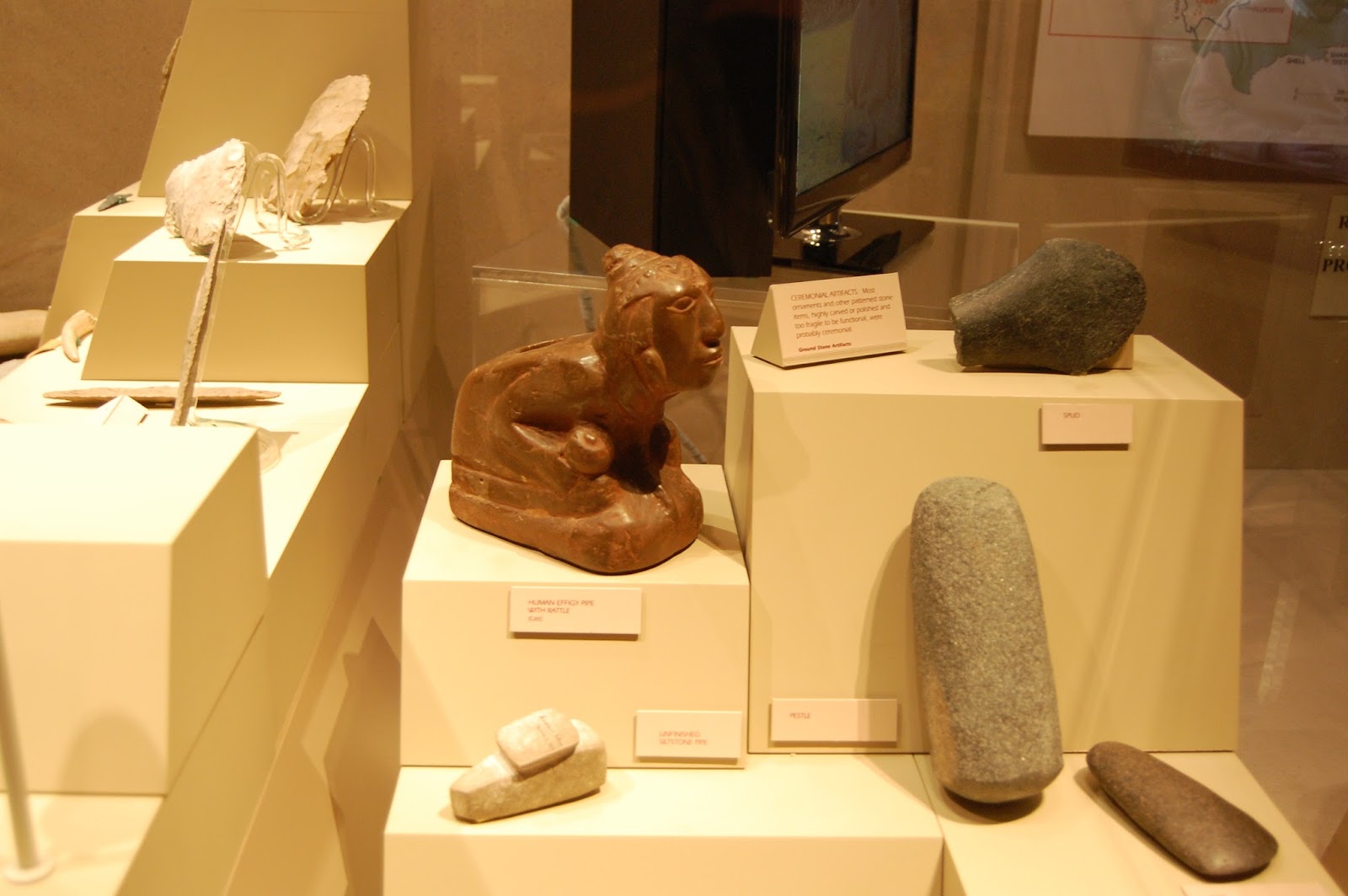


Copper, granite, sandstone, and chert were used to make items and tools at Cahokia.


Markings using body paint were used to indicate status. The man above is a model of an ancient Cahokian who has a celtic cross on his arm with crosses also on his arm and kilt. I do not know for sure if this depiction is accurate and I will do more research to find out how the museum determined skin and hair color for their models.

I was so glad to be able to visit Cahokia. It was a one of my goals for a long time. I have noticed the similarity in mound and mud pyramid styles with all Mississippian peoples' sites. They all had the same societal structure and had a mound or woodhenge to track the seasons of the planet. Many of these ancient cities had wooden stockade fences built around their cities to protect themselves from outsiders who were not of high status or were warring enemies. Many of them had a water source near or behind the largest pyramid/mound as well. For any large city to work, they must have a steady supply of water, food, and fuel. In those days, trees were cut down and burnt for cooking or heat. Once the area was depleated of wood, the group had to move on. It seems to me that the Mississippian culture lasted about 500 years. They were all connected through the Mississippi River and trade and travel were done all along it from upper Wisconsin all the way down to the Gulf of Mexico. I have to wonder if the Mississippian culture was connected to the Mayans or Incans. Perhaps we shall know for sure one day and perhaps we will connect them with Egypt as well.
When I was walking through the Twin Mounds on my way to Mound 72, I saw a tree that had a strange face made of bark on it (looks like one of the old inhabitants of Cahokia). It caught my eye right away. See if you can see it, in the picture below:

I will be looking at the the ancient southwestern people in future studies. I hope you have enjoyed what I have presented in the blog for now. Please read The Library Kids for more information and a journey back in time.
by Rita Jean Moran (www.thelibrarykids.com)


